Venture capital has traditionally been an exercise in patience. Investors identify exceptional founders early, support them through years of company building and ultimately hope that an acquisition or IPO delivers the liquidity event that defines the investment. For decades, this model has produced many of the industry's most successful outcomes and remains at the heart of venture investing.Yet every investment strategy is shaped by the market in which it operates. As markets evolve, so must the way capital is allocated. We believe the rise of artificial intelligence is creating one of those moments.
Buy-and-Hold Was Built for a Slower Market
AI is compressing innovation cycles at an unprecedented pace. Companies are reaching meaningful scale faster than ever before, while competitive advantages can emerge – and disappear – within a matter of months. Entire software categories are being redefined almost overnight. In this environment, simply building a portfolio and waiting for liquidity is no longer sufficient. Venture investing increasingly requires active portfolio management.
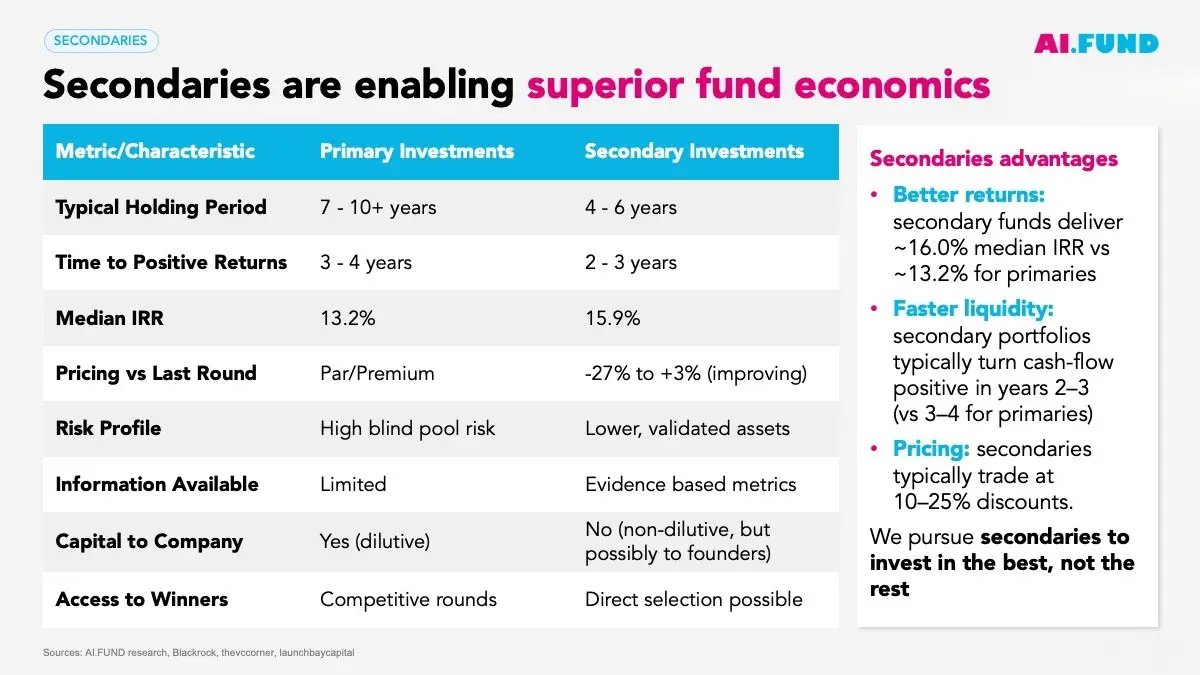
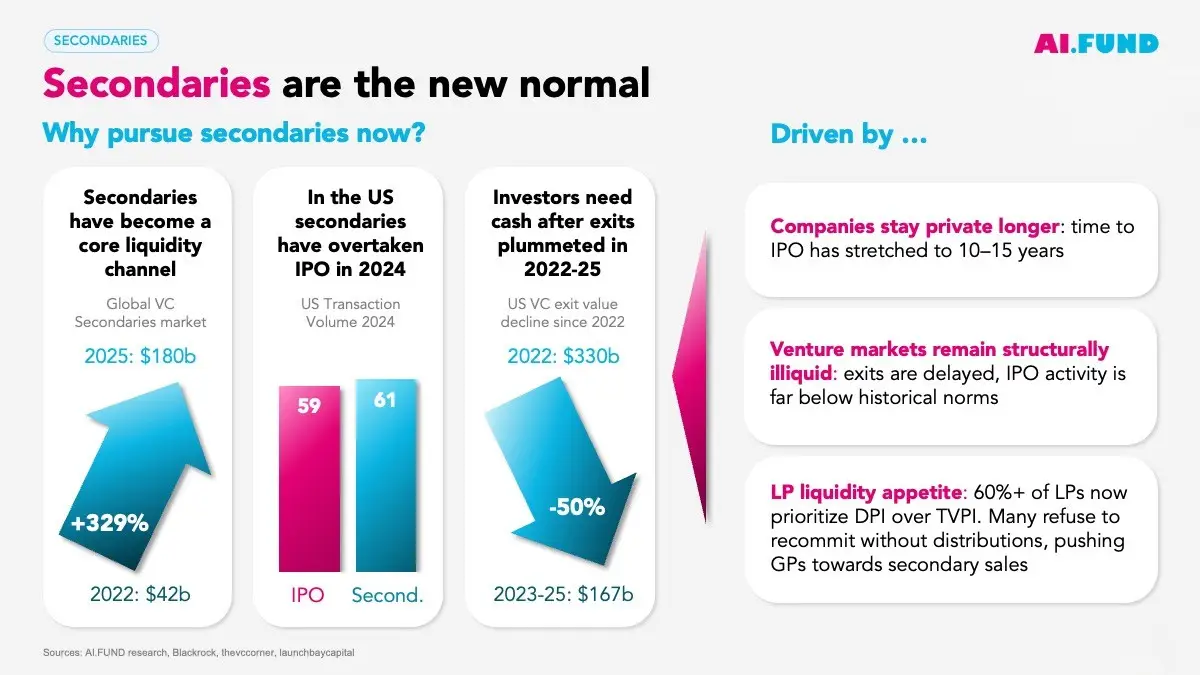
Also, the VC market is still suffering from limited liquidity: Investors often wait for 5 years and more before they can realize first returns from their startup investments. And startups have liquidity needs that often are more dynamic than fits a classic funding round. Secondaries can provide earlier and more flexible liquidity in a market that is starved for cash.
What We Learned Buying Into Companies That Had Already Proven Themselves
This realization emerged from our own experience in AI.FUND I. Over the past two years, we executed both secondary purchases and secondary sales. Initially, we viewed these transactions as opportunistic. Looking back, they fundamentally changed how we think about portfolio construction.
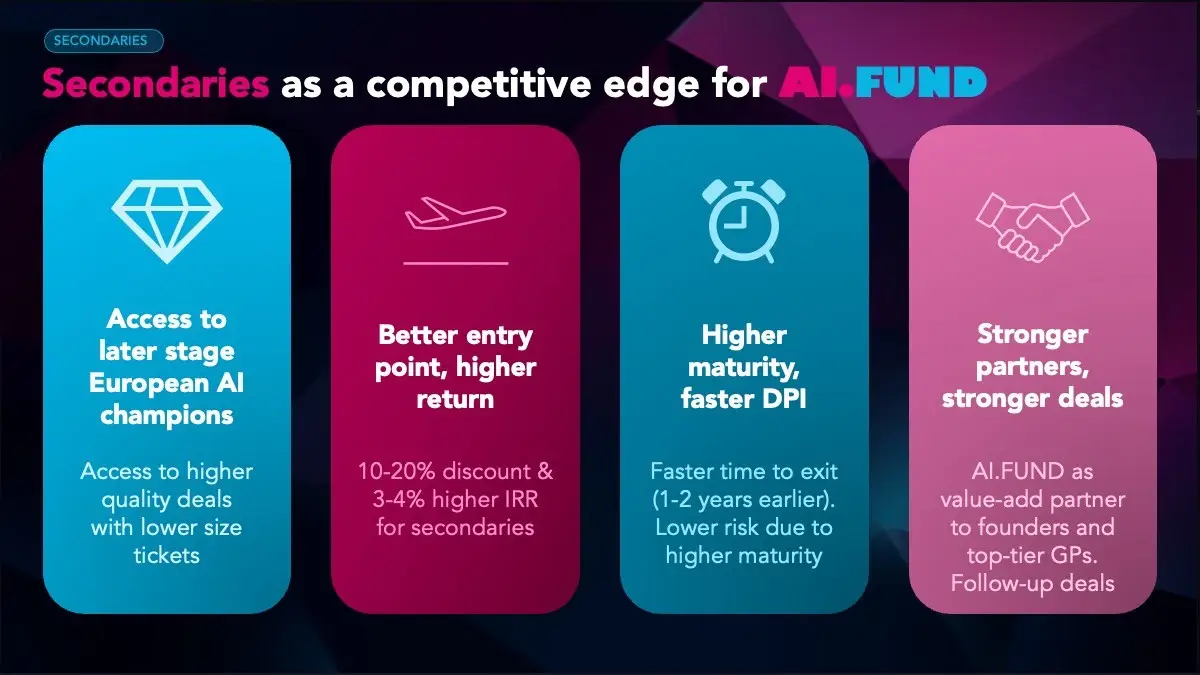
Buying secondary positions allowed us to acquire ownership in companies that had already demonstrated product-market fit, commercial traction, and strong execution. Instead of competing in oversubscribed funding rounds, we were able to invest in businesses with substantially more information available while often entering at attractive valuations. The goal was never simply to buy shares. It was to gain exposure to Europe's emerging AI champions through a different and, in many cases, more attractive route. As outlined in our Fund II strategy, we believe this approach can provide access to later-stage AI leaders, better entry pricing and faster paths to liquidity than many traditional primary investments.
Not Every Winner Should Be Held Until IPO
Equally important, our experience on the sell side challenged another long-held assumption in venture capital: that every successful investment should be held until an IPO or acquisition. While those events remain the most desirable outcomes, they are no longer the only rational moments to realize value.
Selective secondary sales can improve fund construction by returning capital earlier, increasing distributions to investors and creating flexibility to redeploy capital into new opportunities. The objective is not to maximize the return of every individual investment at all costs. It is to maximize the performance of the fund as a whole and to provide tangible returns to investors at an earlier stage. Those objectives are related, but they are not always identical.
The Market Is Catching Up
The broader market reflects this evolution. Companies remain private significantly longer than they did a decade ago, while secondary markets have matured into an increasingly important source of liquidity for founders, employees and early investors. What was once considered a niche segment of venture capital is becoming an integral part of the asset class. Increasingly, secondaries are not a sign that something has gone wrong – they are simply another mechanism through which ownership changes hands as companies mature.
In AI, Capital Should Not Sit Still
For AI investors, we believe this trend is even more pronounced. The pace of technological progress means capital should not remain static. It should continuously migrate towards the strongest companies and, where appropriate, be recycled from mature positions into new opportunities. Portfolio management becomes an active discipline rather than a passive one.
This conviction is one of the reasons why AI.FUND II incorporates secondaries as a dedicated investment strategy alongside traditional primary investments. It is not a departure from venture capital; it is an evolution of it. We continue to believe that exceptional founders create exceptional returns. We simply believe that the tools available to venture investors have expanded.
Looking Ahead
As the AI ecosystem matures, we expect the distinction between primary and secondary investing to become increasingly blurred. The best venture managers will not define themselves by one or the other. They will use both strategically to build stronger portfolios, improve capital efficiency, and create better outcomes for their investors.